
Michigan VINELink Custody Alerts
Michigan VINE is a free, confidential service. It runs 24 hours a day. It covers custody and court-status information, plus notifications when something changes. The Michigan Department of Health and Human Services describes the service. It also links to the Michigan view on VINELink. Searching online is one option. A phone line works too. The alert system follows participating records only. It does not replace the agency that holds a person. Nor does it replace the clerk who keeps a court file.
The official MI-VINE service page explains the statewide purpose and lists 800-770-7657. The page also states that the service stays confidential and free. Alerts can cover release, transfer, escape, and other status events. That applies when the custody or case system reports them. It also requires that the selected event is available. Event options depend on the record and the registration. So do not assume every alert type fits every person.
The service answers a different question than a county jail roster. A roster shows who one facility holds right now. Michigan VINE instead helps you check a covered record and receive later status notices. Neither tool gives a complete history of every arrest.
The MI-VINE information page shows where Michigan sends residents for service details and phone access. It helps when you do not know which local custody system to open first. The page describes the service itself. It does not list current county bookings. Use the separate search interface for a person-specific check.
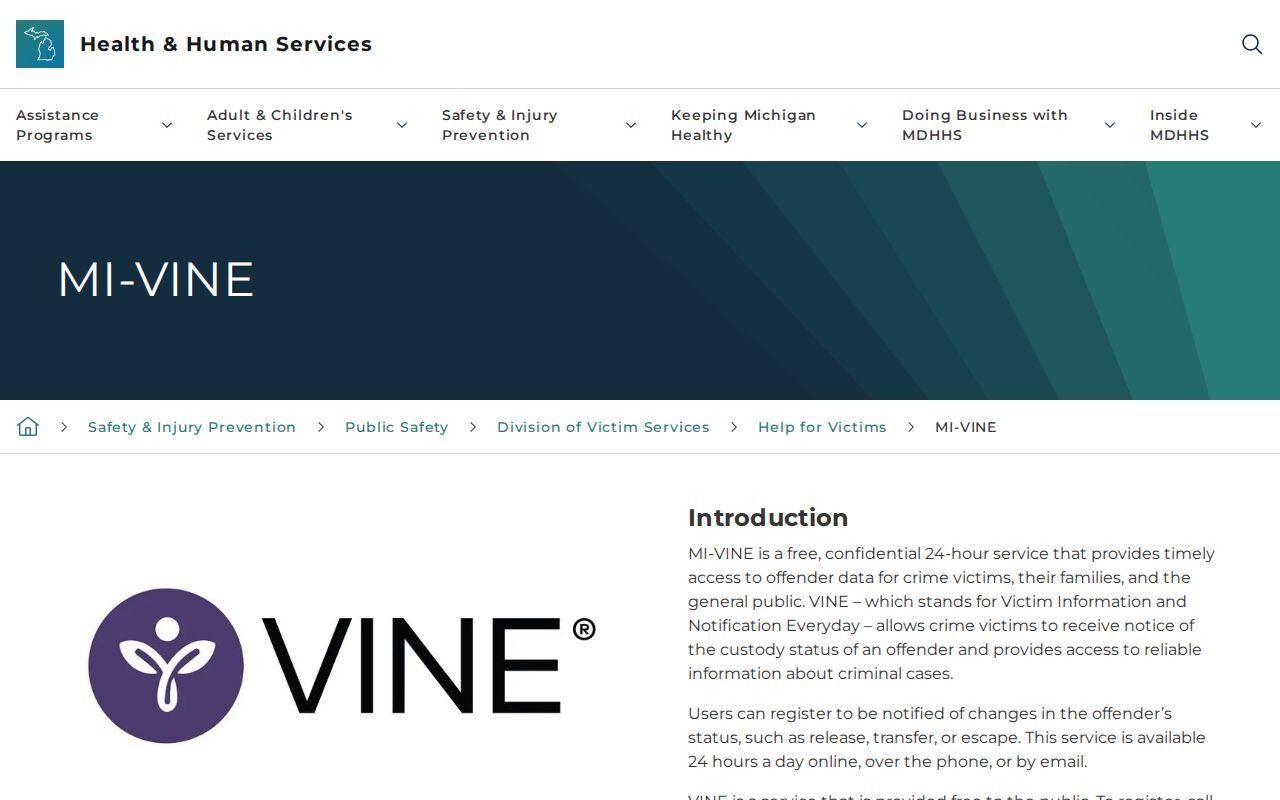
Two pieces matter here. Michigan's service page sets the terms of the custody-notification network, while the search tool supplies person-level results, so keep that split in mind when moving between them.
How to Search Michigan Arrest Custody
Start with the Michigan search and registration interface. Pick Michigan if the state selector is blank. Then use the search options shown for the record. A name search can pull more than one person. Scan the identifying details carefully. Compare the custody location before deciding a result matches your person. Treat these steps as a starting point, and confirm anything urgent with the facility or agency, since participating systems may lag behind an arrest made moments ago.
- Open the Michigan option in VINELink. Check that the state shown is Michigan before entering a name or identifier.
- Enter the person’s name or the offender or booking identifier if known. Use the spelling on official paperwork when possible.
- Review each possible match. Compare the available age or other identifying details, listed facility, status, and case or custody information.
- Open the likely record and read its status and alert choices. If no clear match appears, contact the likely county jail or arresting agency rather than treating the search as a negative result.
Read results narrowly. A match points to a covered custody record. A shared name proves nothing about identity. Someone may have been released before the local entry reached the network, transferred to another facility, booked under a different spelling, cited and released, or held in a system that is not participating. Restricted juvenile and sealed information stays out. A missing result does not rule out an arrest.
Know the arrest county? Its official roster is a strong second check for current jail custody. The Michigan County Directory routes to local county sites whose feeds differ in update schedule and fields. For a new booking, check the county's current view, and contact its records office when a prompt answer matters.
The Michigan VINELink search interface is the official online path for a person-level custody check and any available alert registration.
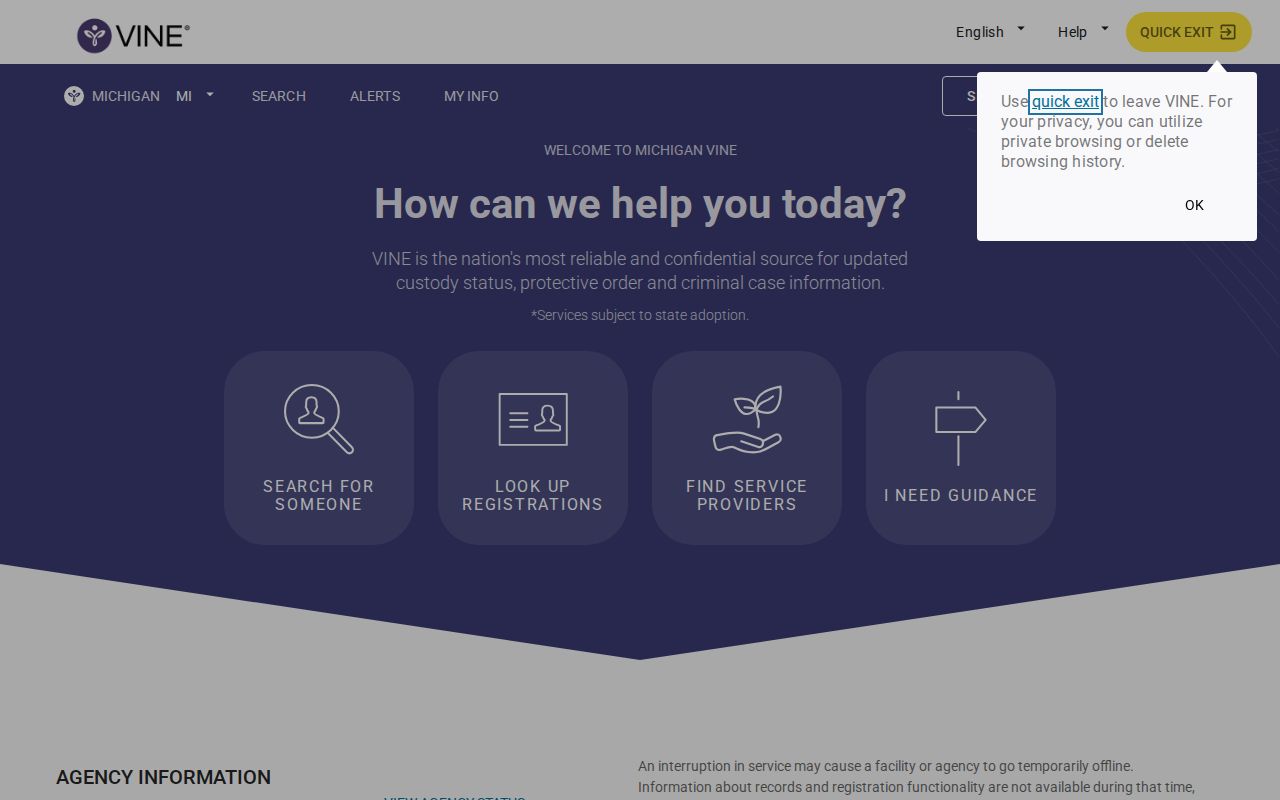
The interface pairs person search with notification choices. A visible search form still does not mean every Michigan arrest sits inside its data.
Michigan VINELink Result Fields
A result is a snapshot from one participating source. It is not a complete arrest file. The displayed fields separate one record from another. They also show where the person is reported to be. Read the labels as the system presents them, and do not stretch them beyond what the official source confirms.
| Displayed detail | How to read it |
|---|---|
| Name or identifier | Use it to compare a possible match. A name alone can match more than one person. |
| Custody status | Shows a status reported by a participating custody or case system. It can change after release, transfer, or another event. |
| Facility or location | Identifies the location associated with the reported record, subject to system updates and transfers. |
| Case or court status | May show available court-related information. Use the court as the source for an official docket or disposition. |
| Notification choices | Shows which alert methods or event types can be selected for that record. |
VINE is not a mugshot service. Treat it as no booking-photo archive either. Its job is status information and alerts. A missing photo does not mean no booking image exists. A photo found somewhere else says nothing about current custody.
When a status carries legal or practical weight, verify the event with its official custodian. County jail staff can confirm a physical hold. The arresting agency handles its own incident record. A court clerk points to the public case record and any later action. The network helps route the question. It does not merge those agencies into one record keeper.
Michigan VINE Reported Coverage
Michigan's VINE participation is broad. But the published count is not a promise that every office, jail, or arrest is included. The FY2024 Crime Victim Services annual report counted MDOC and 72 prosecutor offices. It also counted 81 sheriff offices as participants. Michigan has 83 counties. So two sheriff offices fall outside that count. The report never names them. No public list of the missing offices appears in county material. Guessing which counties they are from a page that never mentions VINE would only mislead.
| System reported | FY2024 participation | What that means |
|---|---|---|
| Sheriff offices | 81 of 83 | The report counted 81 participating offices; it did not identify the two unreported gaps by name. |
| Prosecutor offices | 72 | Prosecutor participation is part of the statewide service count, not proof that every court event appears. |
| MDOC | Participating | State prison and supervision records form a separate layer from county jail bookings. |
| Registered users | 73,267 | The annual report’s FY2024 figure describes registered users, not the number of arrests or alerts sent. |
The participation figures come from the FY2024 Crime Victim Services annual report. Its totals describe one statewide snapshot. A county web page that stays silent proves nothing about its sheriff's participation. Until the state publishes a sourced update, the two uncounted offices must remain unnamed.
The Michigan Courts lay out the county-jail and court-registration path in their Michigan VINE service explanation. MDOC runs its own victim-services path for state-prison custody. County bookings, prosecutor and court information, and prison supervision all matter. They are not one shared database.
Michigan Release and Transfer Alerts
Once a covered record comes up, use the alert options shown on it. MI-VINE is free and confidential. The event list may include release, transfer, escape, discharge, bond, or a court change. Each event appears only when the system supplies it. Phone, email, and text choices depend on what the interface offers. An alert for one event covers just that event. It does not track every later move.
- Open the selected record and review the available notification types. Pick the custody or court events that matter to the safety plan.
- Choose a phone number, email address, or text option if offered. Follow the prompts to submit the contact method.
- Create or enter the requested PIN or confidential confirmation details. Keep them private because they can be used to manage the registration.
- Follow any confirmation step shown on screen or by phone. Save the record details and review the account later if the contact method changes.
Phone registration runs through 800-770-7657, as listed by MDHHS for MI-VINE. The official state service page shows the current registration choices. Treat VINE as a notification tool only. It files no court motion. It changes no custody order. Nor does it create a record the responsible agency never entered.
State-prison help comes separately through MDOC's Crime Victim Services program and its victim notification brochure. Those resources address the state-prison layer. A county jail hold creates a different record and alert path. Register against the custody record that matches the person and facility.
Note: Confirm each requested alert. Update the contact method through the service when a phone or email changes.
When Michigan VINE Misses a Fresh Arrest
A fresh arrest can pass through several hands first. A person might sit in a local holding point, move later to a county jail, or get cited and released without any booking. The arresting agency may not create the intake record either. Every system reaches VINE by its own route. That leaves room for delay. The arrest is still real even when the record lags behind it.
When a current answer matters, set the VINE result beside the county's current custody page and call the facility or records office. Unsure which county made the booking? Start with the arresting agency and the county directory. The statewide 24 Hour Arrests page explains why same-day county views vary. It also shows why a roster can lag an intake.
Federal custody sits outside all of this, no matter how deep Michigan's participation runs. The Federal Bureau of Prisons locator tracks inmates in BOP custody. It holds no county booking data. It posts no booking-photo roster either. Someone held pretrial by the U.S. Marshals may sit in a contract facility before any BOP designation. Immigration detention splits off again; the ICE Online Detainee Locator plays by its own rules. Neither federal locator answers a county arrest search.
After sentencing or release, Michigan state supervision moves to MDOC's Offender Tracking Information System. OTIS is not a county jail roster. An arrest alone does not put someone there. A jail entry, a state-supervision profile, and a federal locator each answer a different question.
A release or transfer notice describes a custody event. For the official outcome, check the court record and confirm with the clerk.